


Your shopping cart is empty!
Radish (Bicolor Mix) - Seeds on Tape
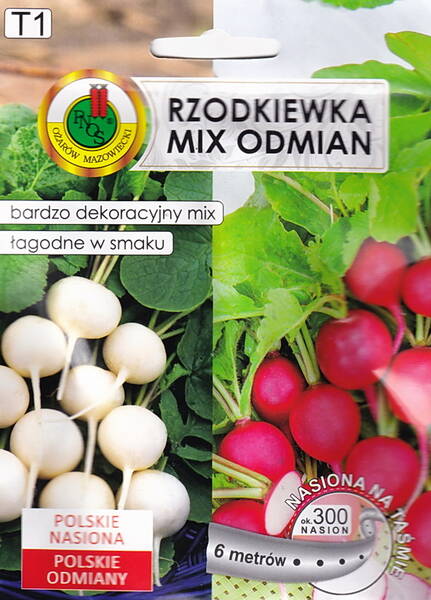
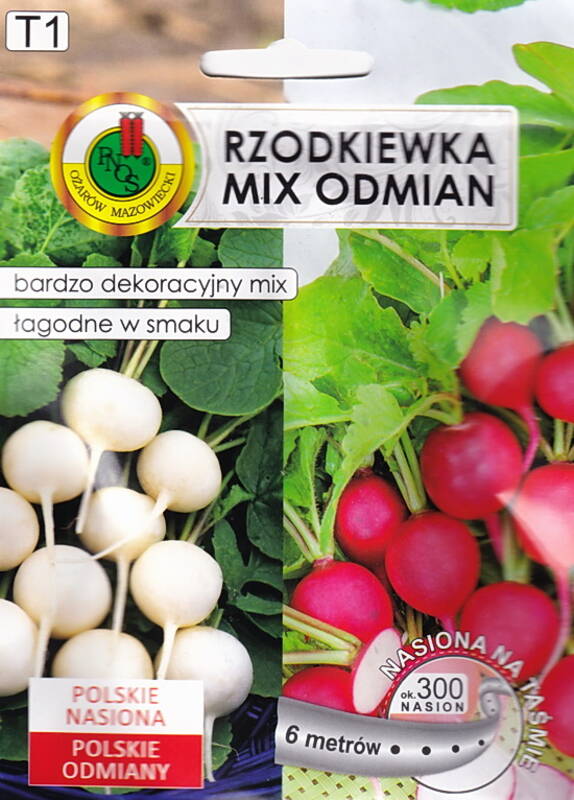
Radish (color mix): "Krasa" + "Sniezka".
Radish Agrotechnics.
It is uncomplicated. Seeds are sown dry into the soil to a depth of 1-1.5 cm. If buried deeper, the roots will be more oval. Radishes are sown in spring, immediately after the snow melts.
Radish is a cold-resistant crop, and the use of covering material during its cultivation allows for earlier produce.
The main mistake of most amateur vegetable growers when sowing radishes is excessive overcrowding of seeds. Because of this, the plant often stretches and does not produce the desired amount of root crops.
It is best to sow radishes individually at a distance of 5x5 cm. This can be done using a marker, but to avoid painstaking work, it can be sown using paper tapes with radish seeds attached at a certain distance (this operation can be done independently if they are glued to strips of ordinary newspaper paper with silicate glue).
Radish grows well at moderate temperatures, from +12 to +16°C. At higher temperatures, the plant grows mainly leaves, not the root crop.
Radish reacts sensitively to the length of the day. With a day length of more than 16 hours, the plant does not form a root crop but switches to bolting and flowering.
Radish can be grown both as a main crop and as an intercrop between rows of carrots, beets, dill, parsley: by the time the main crop sprouts and develops, it will already ripen, and it is easy to remove from the bed.
Harvesting is carried out as the root crops form. Usually, they have a diameter of at least 1.5 cm. At the same time, the leaf blades of the radish are torn off, as they evaporate moisture (without this technique, the root crop becomes flaccid).
One should not be late with harvesting radishes, because when overgrown, the root crop becomes coarse and pithy.

* Radish is one of the most popular early-ripening vegetables. Three harvests of root crops can be collected from the same beds per season.
Loose, moist, fertile soils of neutral or slightly acidic reaction are allocated for radishes.
On structureless and nutrient-poor soils, the vegetable does not form a root crop. Usually, radishes are sown in the ground from April 15 to May 15 and from August 15 to September 1.
This is due to the fact that heat and long daylight hours cause it to bolt, although there are varieties that can be grown throughout the garden season (as soon as the ground thaws and until it freezes again).
When dealing with this crop, do not forget that large, fresh seeds are chosen for sowing. To get a high yield, they must be sown evenly, shallowly embedded in the soil. Thickened sowings do not form root crops.
Radish is cold-resistant but does not tolerate dry and hot weather well: root crops become pithy and bitter.
Radish loves loose, water-absorbing soil rich in fertilizers. For the first sowing, it is prepared in the fall and covered with film, and in the spring, even before the snow melts, it is cleared and as soon as the ground thaws about 20 cm, it is loosened and sowing is carried out.
For 1 square meter of soil, add 1 bucket of manure humus, 1 bucket of rotted sawdust (if not available, 1 bucket of sod land and 1/2 bucket of river sand), 1/2 liter of wood ash, 1/4 liter of garden lime (dolomite flour), 1 tablespoon of superphosphate, 1 tablespoon of nitroammophoska, 1 tablespoon of urea (carbamide), and 1 teaspoon of potassium fertilizer (potassium chloride or potassium sulfate).
All this is evenly scattered over the dug area and dug up again, then leveled with a rake and a bed is formed.
The bed should not be very high and not be sloping so that water does not flow down from it and does not stagnate, creating puddles. Sowing is carried out in transverse grooves 1 cm deep made with a rod. A distance of 5 cm is made between the grooves, and 2-3 cm between the seeds, then the grooves are covered with the same earth, watered with warm water, and covered with covering agrotextile.
As a rule, before germination, the bed covered with covering material does not need to be watered. After the seeds have sprouted, watering is done every 1-2 days, and less often in cold weather.
When the ovary reaches the size of a large pea, watering must be done daily at the rate of 1-2 buckets per square meter. The more intensive the watering, the juicier the radish and the less bitterness. The covering material can be left on for the entire period of growing radishes, however, to slow down growth at the fruiting stage, it is better to open it.